Digestive problems are common, but when symptoms such as persistent acidity, heartburn, stomach pain, indigestion, vomiting, or difficulty swallowing continue for a long time, they may need a closer medical evaluation. In such situations, a gastroenterologist may recommend an Upper GI Endoscopy in Raipur, Chhattisgarh to understand what is happening inside the upper digestive tract.
An upper GI endoscopy, also known as an upper gastrointestinal endoscopy or gastroscopy, is a procedure that allows a gastroenterologist to examine the inner lining of the oesophagus, stomach, and duodenum using a thin, flexible instrument with a camera. It can help doctors investigate symptoms, identify visible abnormalities, and, when required, collect a small tissue sample for further examination.
For people searching for Upper GI Endoscopy in Raipur, Chhattisgarh, understanding why the procedure is recommended, what it can detect, how to prepare, and what happens afterwards can make the process easier and less stressful.
At Dr. Patel Gastro, Liver & Endoscopy Centre, Dr. Rootik Patel provides specialized care for digestive, gastrointestinal, and liver-related concerns. His listed qualifications include M.B.B.S., M.D. (Medicine), and D.M. Gastroenterology.
What Is an Upper GI Endoscopy?
An upper GI endoscopy is a diagnostic procedure used to examine the upper portion of the digestive system.
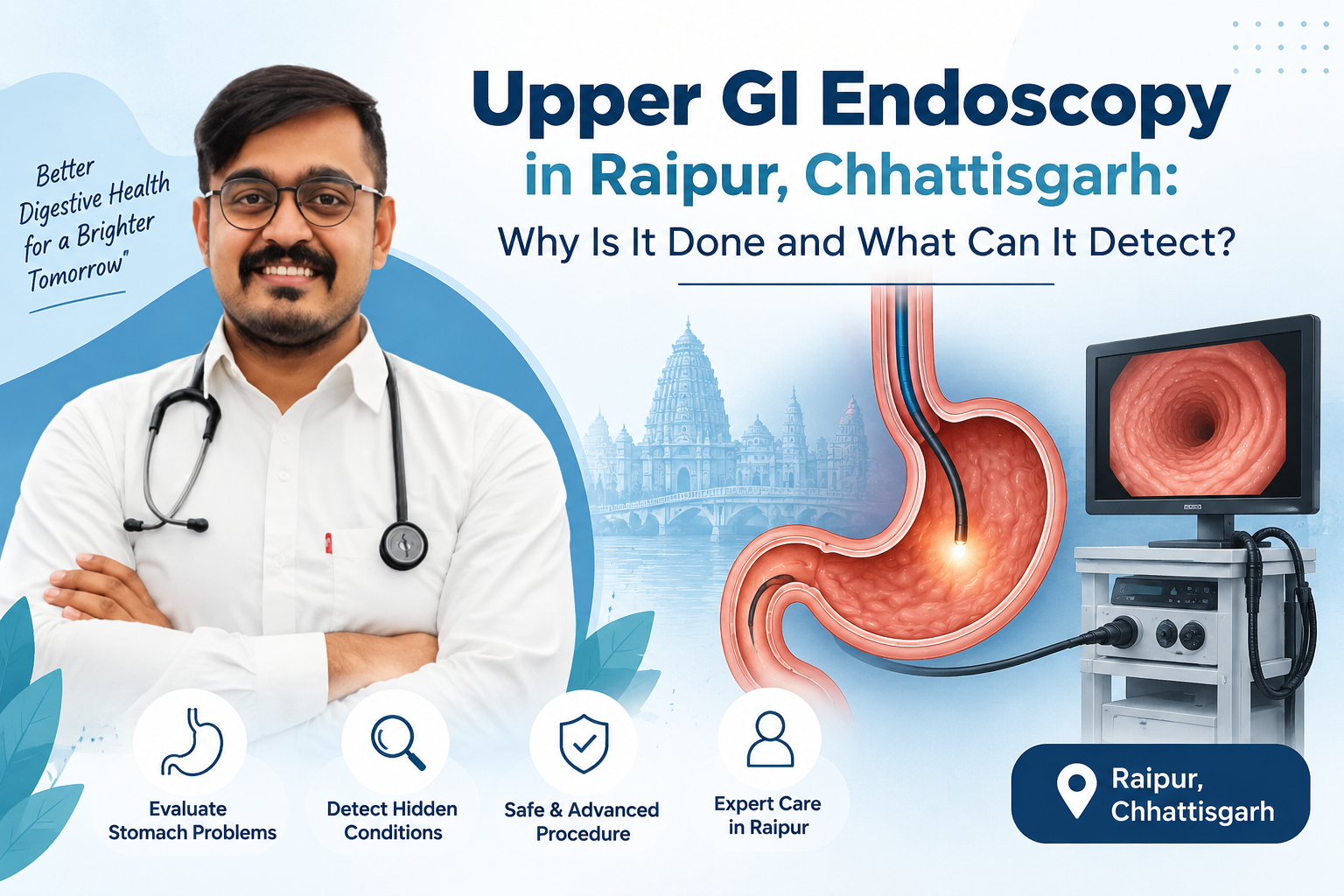
During an Upper GI Endoscopy in Raipur, Chhattisgarh, a flexible tube called an endoscope is carefully passed through the mouth and guided through the oesophagus, stomach, and duodenum. A small camera attached to the endoscope sends images to a monitor, allowing the gastroenterologist to examine the digestive tract directly.
The procedure can help the doctor look for inflammation, ulcers, bleeding, narrowing, unusual growths, or other visible abnormalities.
In certain situations, the doctor may take a small tissue sample called a biopsy. A biopsy can then be examined in a laboratory when additional information is required.
The need for an endoscopy depends on the patient’s symptoms, medical history, examination findings, and the doctor’s clinical assessment. Not everyone with acidity or stomach discomfort necessarily needs an endoscopy.
Why Is Upper GI Endoscopy Done?
There are several reasons why a gastroenterologist may recommend an Upper GI Endoscopy in Raipur, Chhattisgarh. The procedure is generally considered when symptoms are persistent, unexplained, recurrent, or require direct examination of the upper digestive tract.
1. Persistent Acidity and Heartburn
Occasional acidity or heartburn can happen to many people. However, frequent or persistent symptoms may require further evaluation.
If acidity continues despite appropriate treatment or is accompanied by other concerning symptoms, your gastroenterologist may recommend an upper GI endoscopy.
The procedure allows the doctor to examine the oesophagus and stomach for visible changes that may help explain the symptoms.
2. Ongoing Indigestion
Indigestion can cause discomfort in the upper abdomen, fullness after meals, bloating, burning, or nausea.
While many cases may improve with appropriate treatment and lifestyle changes, persistent indigestion may need additional investigation.
An Upper GI Endoscopy in Raipur, Chhattisgarh can help a gastroenterologist directly examine the upper digestive tract when the symptoms indicate that further evaluation may be useful.
3. Persistent Upper Abdominal Pain
Upper abdominal pain can have several possible causes. Some may involve the stomach or upper digestive tract.
When pain is persistent, recurrent, unexplained, or associated with other digestive symptoms, your doctor may recommend investigations to identify the possible cause.
Depending on the clinical situation, an upper GI endoscopy may be included in the evaluation.
4. Difficulty While Swallowing
Difficulty swallowing, medically called dysphagia, should be evaluated when it occurs repeatedly.
Some patients may feel that food is getting stuck or experience discomfort while swallowing. An upper GI endoscopy allows the doctor to examine the oesophagus and look for possible structural or inflammatory abnormalities.
5. Recurrent Vomiting
Repeated or unexplained vomiting may require medical assessment, particularly when it continues or occurs along with abdominal pain, difficulty swallowing, weight loss, or other symptoms.
Depending on the patient’s condition, an endoscopy may help the gastroenterologist examine the upper digestive tract and investigate possible causes.
6. Suspected Gastrointestinal Bleeding
Vomiting blood or passing black, tar-like stools can be signs of bleeding in the digestive tract and require prompt medical evaluation.
When the doctor suspects bleeding from the upper gastrointestinal tract, an upper GI endoscopy may help identify a possible source. In selected cases, endoscopic techniques can also be used to manage certain causes of bleeding.
What Can an Upper GI Endoscopy Detect?
One of the main benefits of an Upper GI Endoscopy in Raipur, Chhattisgarh is that it allows the gastroenterologist to directly examine the lining of the upper digestive tract.
Depending on the patient’s symptoms and clinical situation, the procedure may help evaluate conditions such as:
Gastritis
Gastritis refers to inflammation of the stomach lining. It may be associated with symptoms such as upper abdominal discomfort, nausea, indigestion, or a burning sensation.
During endoscopy, the doctor can examine the appearance of the stomach lining and may take a biopsy when additional evaluation is appropriate.
Peptic Ulcers
Peptic ulcers are sores that develop in the lining of the stomach or duodenum.
An upper GI endoscopy can help identify an ulcer, examine its location and appearance, and provide information that may assist with further management.
GERD-Related Changes
Gastroesophageal reflux disease, commonly known as GERD, occurs when stomach contents repeatedly flow back towards the oesophagus.
An endoscopic examination can allow the gastroenterologist to inspect the oesophageal lining and identify visible changes that may be associated with reflux.
Oesophagitis
Oesophagitis means inflammation of the oesophagus. It can occur for different reasons and may be associated with heartburn, chest discomfort, or swallowing difficulties.
An upper GI endoscopy can help the doctor examine the oesophageal lining and assess visible abnormalities.
Upper Gastrointestinal Bleeding
When upper GI bleeding is suspected, endoscopy can help the gastroenterologist examine the oesophagus, stomach, and duodenum to identify a possible source.
In appropriate circumstances, endoscopic treatment may also be considered.
Narrowing of the Oesophagus
Narrowing of the oesophagus may cause difficulty swallowing or a sensation that food is getting stuck.
An endoscopy can help identify and assess such narrowing and assist the gastroenterologist in deciding what further management may be appropriate.
Abnormal Growths or Lesions
An endoscopy may identify unusual areas, lesions, polyps, or other abnormalities.
If the doctor sees an area that requires further evaluation, a biopsy may be taken.
It is important to understand that an abnormal-looking area does not automatically mean cancer. Further examination, including laboratory testing of tissue when appropriate, may be needed to determine the nature of an abnormality.
How Is an Upper GI Endoscopy Performed?
Many patients feel anxious before their first endoscopy simply because they are unfamiliar with the procedure.
Before an Upper GI Endoscopy in Raipur, Chhattisgarh, the medical team will provide preparation instructions. These instructions may include fasting for a specified period before the examination.
During the procedure, the patient is positioned appropriately and monitored by the healthcare team. The endoscope is carefully introduced through the mouth and guided into the upper digestive tract.
The camera allows the gastroenterologist to view the oesophagus, stomach, and duodenum on a screen.
If necessary, a small biopsy may be collected. Depending on the findings and the patient’s medical needs, selected therapeutic procedures may also be performed during endoscopy.
The duration of the examination can vary depending on the reason for the procedure and whether additional intervention is required.
Is Upper GI Endoscopy Painful?
This is one of the most common questions asked by patients looking for Upper GI Endoscopy in Raipur, Chhattisgarh.
The experience can vary from one person to another. Some patients may experience temporary throat discomfort, gagging, pressure, or bloating.
Appropriate measures may be used to improve patient comfort depending on the procedure and individual circumstances.
If you are nervous about an endoscopy, discuss your concerns with your gastroenterologist before the procedure. Knowing what to expect can help reduce anxiety.
How Should You Prepare for Upper GI Endoscopy?
Preparation is an important part of the endoscopy process.
Your doctor will provide specific instructions based on your medical condition and the planned examination. Patients may generally be asked to avoid food and drinks for a particular period before the procedure.
Before undergoing an Upper GI Endoscopy in Raipur, Chhattisgarh, tell your doctor about:
- Medicines you currently take
- Any known allergies
- Existing medical conditions
- Previous reactions to sedation or anaesthesia
- Blood-thinning medicines
- Previous gastrointestinal procedures
- Relevant medical history
Do not stop or change any prescribed medicine without discussing it with your doctor.
Following the preparation instructions carefully can help the medical team perform the procedure appropriately.
What Happens After Upper GI Endoscopy?
After the examination, you may be monitored for a period before leaving the medical facility.
Some patients may experience temporary throat irritation, mild bloating, or a feeling of fullness.
If sedation has been used, your doctor or medical team may provide additional instructions regarding recovery and going home.
The gastroenterologist will explain the findings and discuss whether further tests, medicines, biopsy evaluation, lifestyle changes, or follow-up care are required.
If a biopsy is taken, the final result may take additional time because the tissue needs to be examined in a laboratory.
Who May Need an Upper GI Endoscopy?
An endoscopy is not automatically required for every digestive complaint.
A gastroenterologist may recommend the procedure when symptoms are persistent, unexplained, recurrent, or associated with warning signs.
You should consider consulting a gastroenterologist if you experience:
- Frequent acidity or heartburn
- Persistent indigestion
- Recurrent upper abdominal pain
- Difficulty swallowing
- Pain while swallowing
- Repeated vomiting
- Vomiting blood
- Black or tar-like stools
- Unexplained weight loss
- Persistent nausea
- Digestive symptoms that do not improve with recommended treatment
The appropriate investigation depends on the individual patient. Your doctor may recommend an endoscopy, another diagnostic test, or a combination of investigations.
Choosing a Gastroenterologist for Upper GI Endoscopy in Raipur
If you are searching for Upper GI Endoscopy in Raipur, Chhattisgarh, selecting a qualified gastroenterology specialist is an important step.
Many patients use online searches such as Best Gastroenterologists in Raipur Chhattisgarh when looking for a doctor. Search listings can help you discover gastroenterologists in your area, but the final choice should be based on factors such as qualifications, specialization, relevant clinical experience, available services, communication, and your individual healthcare requirements.
A gastroenterologist can assess your symptoms and determine whether an endoscopy is actually necessary.
When researching the Best Gastroenterologists in Raipur Chhattisgarh, patients should also look for a doctor who can explain the procedure clearly and help them understand the purpose of the recommended investigation.
Dr. Rootik Patel – Gastroenterology Specialist in Raipur
Dr. Rootik Patel is a gastroenterology specialist associated with Dr. Patel Gastro, Liver & Endoscopy Centre in Raipur.
His listed qualifications are:
- M.B.B.S.
- M.D. (Medicine)
- D.M. Gastroenterology
His specialized training in medical gastroenterology focuses on the diagnosis, evaluation, and management of digestive system and gastrointestinal conditions. The clinic states that Dr. Rootik Patel follows a patient-focused approach and aims to explain conditions and treatment options in simple language.
For patients researching the Best Gastroenterologists in Raipur Chhattisgarh, qualifications and relevant specialization are important factors to consider when selecting a gastroenterology specialist.
At Dr. Patel Gastro, Liver & Endoscopy Centre, the listed services include Upper GI Endoscopy along with other digestive and endoscopic services.
Upper GI Endoscopy in Raipur, Chhattisgarh at Dr. Patel Gastro, Liver & Endoscopy Centre
For patients looking for Upper GI Endoscopy in Raipur, Chhattisgarh, Dr. Patel Gastro, Liver & Endoscopy Centre provides specialized gastroenterology and endoscopy services.
The centre’s stated focus includes digestive, liver, and gastrointestinal conditions, with an emphasis on personalized treatment guidance and patient-centered care.
The clinic is located at:
Dr. Patel Gastro, Liver & Endoscopy Centre
2nd Floor, Bhawani Diagnostic Centre
Fafadih Chowk, Raipur Road
Raipur, Chhattisgarh – 492001
Consultation Hours: Monday – Saturday, 4:30 PM – 7:30 PM
Phone: +91 62611 46572
Patients considering an Upper GI Endoscopy in Raipur, Chhattisgarh can discuss their symptoms and medical history with the gastroenterology specialist to understand whether the procedure is appropriate for them.
Why Is Direct Examination Important?
Digestive symptoms can overlap between different conditions. Acidity, indigestion, nausea, stomach discomfort, and swallowing difficulties can have several possible causes.
This is why symptoms alone may not always provide enough information for an accurate evaluation.
An Upper GI Endoscopy in Raipur, Chhattisgarh provides direct visual information about the upper digestive tract. It allows the gastroenterologist to examine areas that cannot be assessed through a routine external examination.
When appropriate, the doctor may also take a biopsy or perform selected endoscopic interventions.
This makes upper GI endoscopy an important diagnostic tool when a patient’s symptoms or clinical findings indicate that direct examination is needed.
How to Find the Best Gastroenterologists in Raipur Chhattisgarh?
When people search for Best Gastroenterologists in Raipur Chhattisgarh, they may find several doctors and healthcare centres.
Instead of relying only on a ranking or online label, consider the following:
Check Qualifications
Look for relevant medical qualifications and specialized training in gastroenterology.
Consider the Required Service
If you have been advised to undergo an endoscopy, check whether the gastroenterologist provides the relevant endoscopic service.
Discuss Your Symptoms
A good consultation should allow you to explain your symptoms, medical history, previous reports, and concerns.
Understand the Procedure
Before undergoing an endoscopy, ask your doctor about preparation, the purpose of the procedure, possible findings, recovery, and follow-up.
Choose Appropriate Medical Care
The most suitable gastroenterologist depends on your individual medical needs. Online searches for Best Gastroenterologists in Raipur Chhattisgarh can be a starting point, but your final decision should be based on appropriate professional and healthcare considerations.
Frequently Asked Questions About Upper GI Endoscopy
1. What is Upper GI Endoscopy?
Upper GI endoscopy is a procedure that allows a gastroenterologist to examine the oesophagus, stomach, and duodenum using a flexible endoscope with a camera.
2. Why is Upper GI Endoscopy recommended?
It may be recommended for persistent acidity, heartburn, indigestion, upper abdominal pain, swallowing difficulties, recurrent vomiting, suspected gastrointestinal bleeding, or other symptoms that require further evaluation.
3. Can Upper GI Endoscopy detect ulcers?
Yes. An upper GI endoscopy can help identify ulcers in the stomach or duodenum and allows the doctor to examine them directly.
4. Can endoscopy detect gastritis?
An endoscopy can show visible changes in the stomach lining that may be associated with gastritis. In some cases, the doctor may also take a biopsy for additional evaluation.
5. Does everyone with acidity need an endoscopy?
No. Occasional acidity does not automatically mean that an endoscopy is required. Your doctor will consider the frequency and severity of symptoms, medical history, response to treatment, and other relevant factors.
6. Is Upper GI Endoscopy painful?
Patients may experience temporary discomfort, gagging, throat irritation, or pressure. Your medical team can explain the comfort measures and procedure details beforehand.
7. How should I prepare for Upper GI Endoscopy in Raipur, Chhattisgarh?
Your gastroenterologist will provide specific preparation instructions. These may include fasting for a particular period and discussing your current medicines and medical history.
8. Where can I get Upper GI Endoscopy in Raipur, Chhattisgarh?
Upper GI Endoscopy is listed among the specialized procedures at Dr. Patel Gastro, Liver & Endoscopy Centre, located at the 2nd Floor, Bhawani Diagnostic Centre, Fafadih Chowk, Raipur Road, Raipur, Chhattisgarh 492001.
9. How can I find the Best Gastroenterologists in Raipur Chhattisgarh?
When searching for the Best Gastroenterologists in Raipur Chhattisgarh, consider the doctor’s qualifications, gastroenterology specialization, relevant experience, available services, communication style, and whether the doctor is suitable for your specific medical needs.
10. When should I seek urgent medical attention?
Vomiting blood, black or tar-like stools, severe abdominal pain, fainting, or significant weakness can require prompt medical evaluation. Do not delay urgent medical care while waiting for a routine consultation.
Conclusion
An Upper GI Endoscopy in Raipur, Chhattisgarh can be a valuable diagnostic procedure when persistent or unexplained digestive symptoms require a closer examination.
It allows a gastroenterologist to directly examine the oesophagus, stomach, and duodenum and may help evaluate conditions such as gastritis, peptic ulcers, reflux-related changes, oesophageal inflammation, bleeding, narrowing, and other abnormalities.
However, not every person with acidity, indigestion, or stomach discomfort needs an endoscopy. The decision should be based on your symptoms, medical history, clinical examination, and the recommendation of a qualified gastroenterologist.
For patients searching for Upper GI Endoscopy in Raipur, Chhattisgarh, Dr. Patel Gastro, Liver & Endoscopy Centre lists Upper GI Endoscopy among its specialized services. Dr. Rootik Patel is listed with M.B.B.S., M.D. (Medicine), and D.M. Gastroenterology qualifications.
Patients researching the Best Gastroenterologists in Raipur Chhattisgarh can consider relevant qualifications, specialization, available gastroenterology services, and their individual healthcare requirements when choosing a specialist.
If you are experiencing persistent acidity, recurrent stomach discomfort, difficulty swallowing, unexplained vomiting, or other ongoing digestive symptoms, consult a gastroenterologist to understand the possible cause and whether an Upper GI Endoscopy in Raipur, Chhattisgarh may be appropriate for you.
Medical Disclaimer: This article is intended for general educational purposes only. It should not replace professional medical consultation, diagnosis, or treatment. The need for an endoscopy should be determined by a qualified healthcare professional based on your individual symptoms and medical history.